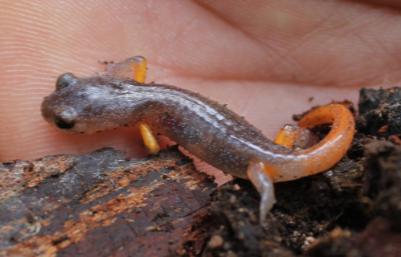
 | Please don’t mistake my candidness for a sappy cliché when I say my passion for the natural world began practically from birth. You see, I grew up in the foothills of the northern coast range in California, and from a very young age I played outside whenever possible. I was never taught to fear wild animals; instead I learned to respect the venomous black widow spiders and rattlesnakes and to adore the frogs, toads and newts that appeared only after the rain. Much of this was thanks to my father. When I was very small, my father did worry I might accidentally stumble upon a rattlesnake and get bitten, but instead of killing every snake he saw as some of our neighbors did, he would relocate it a few miles away in an empty field. The tenderness with which he handled those animals made a huge impression on me, not only did I have little to fear from a snake treated with care, but these animals had inherent value as living creatures. |
Unfortunately, my high school didn’t offer any biology classes beyond one year of introductory studies which I took as a freshman, so my favorite classes were English and art, and for a long time I never seriously considered being a scientist. I graduated high school a year early as class Valedictorian, but felt completely directionless. For the next several years I would zigzag through life, unable to hone in on anything that felt like the right path. Immediately after graduation, though I was just seventeen, I spent several months wandering around Spain, France and England by myself, hoping, I guess, to get a handle on my future. It was not easy, and I learned a lot about being self-sufficient, but when I got home I was no more sure about my future than before. Next, I worked for an archaeological survey company, tried to study anthropology at UC Santa Cruz, dropped out, then worked at a ski resort, on a cattle ranch and in a record store before finally coming to rest for a few years in a customer service position at a luxury hotel in Seattle. By my second year there, I was being groomed for a management position, but the thought of making a career in hospitality was abhorrent. I was 22 years old, I had yet to do anything meaningful with my life, and frankly, I was profoundly bored. Boredom can breed self-reflection, and as I sat in my bland, white walled, windowless office, I tried to remember a time when I had truly been happy. What came to me were those days spent outside in the rain as a child, and I began to wonder again about the secret lives of toads and newts. I still didn’t know what sort of career that meant I should head for, so I visited a community college career counselor who introduced me to the concepts of wildlife and conservation biology. It was love at first reading-of-the-career-summary, and so I started school again with fervor.
I’ve come a long way since that afternoon in the career counselor’s office. I’ve gained faith in myself as a student and researcher, and I know now that a career in conservation biology research, where learning, field work, teaching and meeting new people, and going new places will always be a part of my life is the only job I can imagine doing. I have worked many field jobs and a few lab positions, and I have several independent research projects in progress at this point, but this spring, I finally got to have my own team as I led a group of five other undergraduates in conducting anuran call surveys and dipnet surveys at 25 water features across the city of Davis and the UC Davis campus. I enjoyed teaching them the skills they needed for the project and sharing the experience of conducting what was for several of them, their first field research project. And I enjoyed providing them with a new opportunity. I have found that undergraduate students can be at a distinct disadvantage at a research university when they don’t yet have any research experience. Getting someone to let you into their lab when they don’t know you and you don’t have a strong background in field or lab work can be nearly impossible. So, when I selected my team members, I took a mixture of students, some who had field experience and some who didn’t have any. I believe it’s important to give chances to people who haven’t proved themselves yet because they’ll often be the ones who surprise you. As it turned out, the most enthusiastic member of my team was a freshman who knew nothing about frogs.
My work this spring required me to contact many non-scientist community members for permission to access ponds and I successfully developed a positive rapport with all of them. One of the most important things we can do as conservation biologists is include the community in our research so that the people who live and work near sites we study can gain a sense of stewardship and appreciation for the wildlife that lives alongside them, and I believe I was able to do this by getting landowners and land managers excited about my project. In addition to the research part of the project, my team and I participated in a family education day on campus. We brought a number of native and exotic reptile and amphibian species and spent an afternoon introducing these animals to kids and their parents. It was incredibly rewarding to watch children and adults of all ages get excited about wildlife and lose their fears of animals such as snakes, which are frequently given negative portrayals in our culture. Most people don’t get the childhood experiences I had, and as a consequence, I think it isn’t surprising that some don’t appreciate the wildlife around them. While research will always be my main career focus, I have come to believe strongly in the value of community outreach programs, and I will always make an effort to share my knowledge and love of nature with others.
This project impressed upon me the value of managing wildlife adaptively. In Davis, frogs live and breed around artificial ponds and wetlands. Understanding how amphibians use highly modified habitats, such as those found in urban areas, will help us determine how to manage those habitats better. A great deal of literature can be found on the use of artificial water sources by amphibians, but little has been written about their use of the upland habitats around those water sources. Studies have shown clearly that the buffer areas around such places are often much too narrow and that the lack of suitable upland habitat reduces the size of the amphibian populations at a site. However, at some locations in Davis, frogs are seen well into the suburban neighborhoods surrounding artificial wetlands, they even keep people awake at night calling. Clearly, the minimal buffer around the wetlands is not large enough, but some species appear to be able to move past it and into the suburban landscape, apparently finding suitable microhabitats for foraging and refuge within that seemingly unsuitable area. Once the features that are suitable for amphibians were identified, such features could be made more numerous and even installed in the matrix between water sources to create corridors of connectivity between multiple sites. I value open spaces and wildlife preserves as much as anyone, but I think it’s clear that as the human population continues to increase, so will the lands and watersheds altered for human development. If we allow the lands used by humans to be areas devoid of all but a few species of wildlife, we stand a greater risk of losing species entirely than if we can make human spaces suitable for many species. Conservation work should make a positive impact on wildlife and I believe that will be the effect if I can learn how to make human modified spaces biodiversity friendly.
